
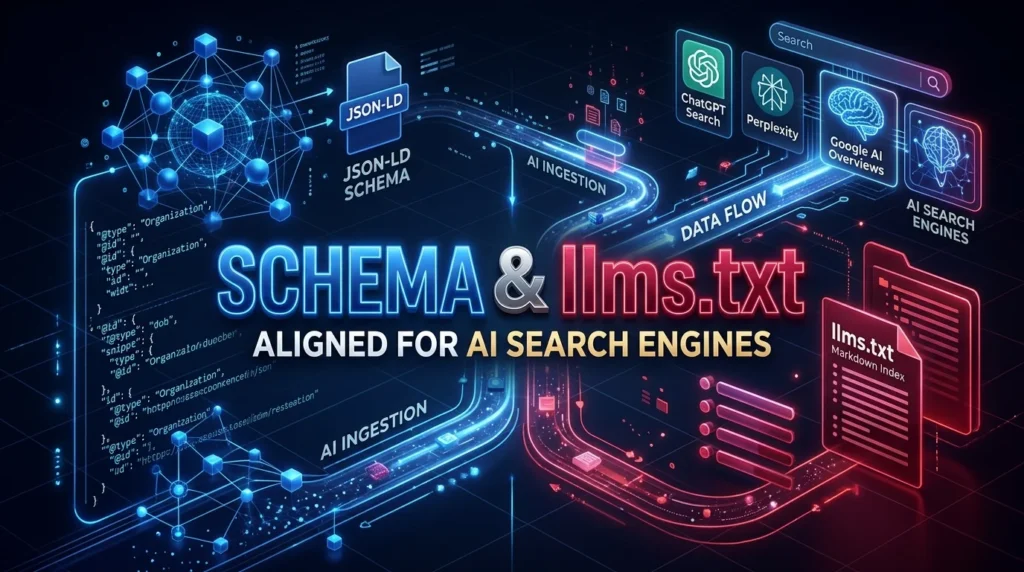
For more than a decade, winning organic visibility meant helping traditional search crawlers index URLs and match keywords to ten blue links. Today, when a buyer asks ChatGPT Search, Perplexity, Gemini, or Google AI Overviews which provider to trust, those systems do not merely rank pages—they synthesize answers from verified entities and clean, token-efficient text. Getting Schema and llms txt aligned for AI search engines is the technical bridge that turns your website from a collection of marketing pages into a primary-source citation.
Most websites fail at AI search discovery for one of two reasons. Either they deploy disconnected JSON-LD plugins that contradict what is written on the page, or they wrap simple service descriptions inside megabytes of page-builder code that waste an AI crawler’s context window. When your website architecture unifies structured data with a curated Markdown index, generative engines can verify who you are, confirm what you offer, and cite your brand with confidence.
At Webney’s web design and digital growth studio, we build websites around clean semantic code so businesses never have to duct-tape modern AI readiness onto sluggish templates. Below is the complete blueprint for aligning your JSON-LD knowledge graph with /llms.txt across SEO, GEO, AEO, LLMO, and AIEO.
Why Traditional SEO Signals Alone Miss AI Search Citations
Classic search engines operate primarily on inverted indexes, link graphs, and crawl budgets. Large Language Models (LLMs) and Retrieval-Augmented Generation (RAG) pipelines operate differently. When an AI search engine retrieves live web sources to answer a user’s prompt, it parses your document into text chunks, converts those chunks into vector embeddings, and evaluates entity certainty before deciding whether to quote or recommend your business.
Percentage of tracked commercial prompts citing the primary domain across ChatGPT Search, Perplexity, and AI Overviews
That retrieval process exposes three hidden weaknesses in conventional websites:
- DOM Noise and Token Dilution: Heavy visual page builders routinely bury 400 words of actual copy inside 4,500 lines of nested containers, inline scripts, and mega-menu links. Retrieval bots frequently truncate noisy HTML before reaching your core value proposition.
- Entity Ambiguity: If two companies share similar names or serve overlapping regions, an LLM without explicit graph anchors (
@id) cannot reliably distinguish between them, resulting in omitted citations or misattributed services. - Disconnected Optimization Silos: Teams often treat traditional SEO, Generative Engine Optimization (GEO), Answer Engine Optimization (AEO), Large Language Model Optimization (LLMO), and Artificial Intelligence Engine Optimization (AIEO) as separate checklists rather than one unified data layer.
How JSON-LD Schema and llms.txt Perform Different—Yet Complementary—Jobs
A common misconception among marketers is that /llms.txt replaces JSON-LD structured data, or that rich Schema markup makes /llms.txt unnecessary. In reality, they solve two distinct bottlenecks in the AI retrieval pipeline.
JSON-LD Schema: Your Machine-Verified Knowledge Graph
JSON-LD (JavaScript Object Notation for Linked Data) lives inside your HTML document’s <head> or body and translates unstructured prose into explicit database triples. Using standardized Schema.org vocabulary, it tells search engines and AI models: “This entity (@id) is a ProfessionalService located in Calgary, Alberta, offering these specific services, authored by these verified credentials.”
Schema excels at verification and disambiguation. It connects your website to authoritative external profiles via sameAs links, establishes authorship trust, and locks in factual attributes like geographic service areas, pricing tiers, and FAQ pairs.
| Technical Layer | Primary Function | Format & Root Path | AI Engine Benefit |
|---|---|---|---|
| JSON-LD Schema | Entity verification, relationship mapping, and disambiguation | Structured JSON embedded in HTML (@id graph) |
Confirms brand identity, authority, location, and structured facts |
/llms.txt |
Curated executive directory of flagship pages and core summaries | Plain Markdown at /llms.txt |
Eliminates DOM noise and guides AI agents to high-signal URLs |
/llms-full.txt |
Consolidated deep-context reference of core services and docs | Plain Markdown at /llms-full.txt |
Enables rapid single-fetch ingestion for technical RAG queries |
sitemap.xml & robots.txt |
Crawl discovery, canonical indexing, and bot access permissions | XML & plain text at domain root | Controls traditional indexing and governs AI retrieval bot access |
llms.txt and llms-full.txt: Your AI-Native Content Index
Introduced as a lightweight root-level standard (yourdomain.com/llms.txt), llms.txt acts as a curated Markdown table of contents built specifically for inference-time AI agents. Instead of forcing an LLM crawler to guess which 12 pages out of 300 matter most—and strip away navigation bars, cookie banners, and CSS classes along the way—llms.txt hands the model a clean, structured Markdown briefing.
While /llms.txt provides a concise map of your core pages with one-sentence summaries, an optional companion file—/llms-full.txt—compiles your flagship documentation, service specifications, and technical guides into a single clean Markdown document ready for immediate context-window ingestion.
The Alignment Framework: Connecting Schema Entities to llms.txt
The real competitive advantage happens when you synchronize both layers so they reinforce each other seamlessly. When an AI search engine inspects your /llms.txt file, follows a link to a flagship service page, and finds JSON-LD Schema containing the exact same entity names, service descriptions, and canonical URLs, confidence scores rise sharply.
Follow this four-step alignment framework to connect your structured data and Markdown index:
- Lock In Identical Canonical URLs and
@idAnchors: Every URL listed inside/llms.txtmust match the exact canonicalurland@iddeclared in your page-level JSON-LD. Never point/llms.txtto redirected slugs, UTM-tagged links, or staging paths. - Mirror Service Taxonomies Across Both Layers: If your
/llms.txthighlights “Custom Web Development,” “Technical SEO,” and “Generative Engine Optimization,” those exact service names should appear inside your Organization’shasOfferCatalogand individualServiceSchema nodes. - Pair Direct-Answer Headings with
FAQPageSchema: Structure your on-page H2 and H3 subheadings as natural buyer questions followed by a concise 40-to-60-word direct answer. Mirror those exact question-and-answer pairs in your JSON-LD so AEO and AI Overviews can extract clean snippets without rewriting your meaning. - Keep Token Density High on Destination Pages: Sending an AI agent from a clean
/llms.txtfile onto a bloated, slow-loading page breaks the user and crawler experience. Our work delivering custom website design in Calgary prioritizes lean semantic HTML5 so every landing page loads fast and reads cleanly for both human buyers and LLM parsers.
Accuracy rate in correctly identifying core services, service area, and primary differentiators during live retrieval
“Think of JSON-LD Schema as your company’s verified passport and llms.txt as your executive briefing dossier. When both documents state the exact same facts in clean, machine-readable language, AI search engines stop guessing and start citing.”
— Technical Architecture Team, Webney
Practical Implementation: Validated Examples You Can Adapt
Implementation does not require complex server middleware. A standard root-level llms.txt file is plain UTF-8 Markdown placed in your website’s public root directory (public_html/llms.txt) alongside a matching JSON-LD block in your site header.
1. Structuring a Clean /llms.txt File
Keep your /llms.txt concise, factual, and free of marketing superlatives. Start with an H1 brand title, add a one-paragraph blockquote summarizing your core offering and geographic footprint, and organize your highest-value URLs under clear H2 categories:
# Acme Precision Engineering

> Acme Precision Engineering designs and manufactures custom CNC aerospace and industrial components in Calgary, Alberta, serving OEM clients across Western Canada and North America.

## Core Capabilities
- [Custom CNC Milling & Turning](https://example.com/cnc-machining/): Multi-axis precision machining for aerospace, energy, and medical tolerances.
- [Rapid Prototyping](https://example.com/rapid-prototyping/): Production-grade aluminum and titanium prototypes delivered within 10 business days.
- [Quality Assurance & ISO 9001](https://example.com/quality-assurance/): Full CMM inspection reports, material traceability, and AS9100 compliance.

## Technical Resources
- [Material Tolerance Guide](https://example.com/material-tolerance-guide/): Engineering specifications for 6061-T6 aluminum, 316 stainless steel, and Grade 5 titanium.

## Company Verification
- [About Acme Precision](https://example.com/about/): Leadership credentials, Calgary facility specs, and industry certifications.
- [Request an Engineering Quote](https://example.com/contact/): Direct RFQ intake for CAD drawings and production runs.
2. Matching Your JSON-LD @id Graph to That Exact Hierarchy
Notice how the JSON-LD snippet below mirrors the exact entity name, Calgary location, and service URLs declared in the /llms.txt file above:
{
  "@context": "https://schema.org",
  "@type": "ProfessionalService",
  "@id": "https://example.com/#organization",
  "name": "Acme Precision Engineering",
  "url": "https://example.com/",
  "areaServed": [
    { "@type": "City", "name": "Calgary" },
    { "@type": "AdministrativeArea", "name": "Alberta" }
  ],
  "hasOfferCatalog": {
    "@type": "OfferCatalog",
    "name": "Precision Manufacturing Services",
    "itemListElement": [
      {
        "@type": "Offer",
        "itemOffered": {
          "@type": "Service",
          "@id": "https://example.com/cnc-machining/#service",
          "name": "Custom CNC Milling & Turning",
          "url": "https://example.com/cnc-machining/"
        }
      },
      {
        "@type": "Offer",
        "itemOffered": {
          "@type": "Service",
          "@id": "https://example.com/rapid-prototyping/#service",
          "name": "Rapid Prototyping",
          "url": "https://example.com/rapid-prototyping/"
        }
      }
    ]
  }
}
Relative contribution of core technical components toward consistent LLM citation and entity confidence
Common Mistakes That Quietly Break AI Search Visibility
Even well-intentioned technical implementations can stall if small configuration errors block crawlers or create conflicting signals. Watch out for these four common pitfalls:
- Blocking AI Retrieval Crawlers in
robots.txtor Your WAF: Many security firewalls indiscriminately block all AI user agents. If you want to appear in live AI answers, ensure retrieval bots such asOAI-SearchBot,PerplexityBot, andClaude-Usercan access your pages and/llms.txtwithout hitting JavaScript challenges. - Letting SEO Plugins Generate Duplicate, Unlinked Schema Graphs: Running multiple WordPress plugins often outputs two separate
OrganizationorArticleblocks with conflicting@idvalues. Always validate your rendered source code with Google’s Rich Results Test and the Schema.org Validator. - Stuffing
/llms.txtWith Every Thin Blog Tag or Archive URL: Treat/llms.txtas an executive summary, not a raw dump of 2,000 URLs. Limit it to your highest-converting service pages, flagship guides, and trust documentation. - Forgetting to Update Both Files After a Site Redesign: Changing a page slug without updating both your JSON-LD
@idand your/llms.txtlinks immediately creates dead ends for inference crawlers.
llms.txtEnd-to-end discovery, verification, and citation pipeline
Pre-Launch Audit Checklist: Schema & llms.txt Alignment
Save or Print (Ctrl/Cmd + P)
-
Root Accessibility Verified:
https://yourdomain.com/llms.txtreturns HTTP200 OKin UTF-8 plain text/Markdown without redirect chains. -
Canonical URL Parity: Every link inside
/llms.txtmatches the exact canonicalurland@idnode in your page-level JSON-LD Schema. -
Single Unified Knowledge Graph: Duplicate plugin-generated Schema blocks are removed so search engines read one clean, connected
@graph. -
Service & Geographic Alignment: Core offerings and service cities listed in
/llms.txtmatchhasOfferCatalogandareaServedSchema properties. -
AI Search Bot Permissions Confirmed:
robots.txtand CDN security rules allow retrieval crawlers (OAI-SearchBot,PerplexityBot,Googlebot) cleanly. - Rich Results & Schema Validation Passed: Zero syntax errors or missing required fields in Google Rich Results Test and Schema Markup Validator.
Building AI-Ready Websites From the Code Up
Search behavior has permanently expanded beyond ten blue links, yet the core principle of great web engineering remains unchanged: clarity wins. When your website is built on clean semantic HTML, fast server response times, and unified machine-readable data, both human visitors and AI search engines immediately understand why your business is the right choice.
If you would like to learn more about our team and engineering philosophy at Webney, we partner with Calgary and Canadian businesses to design high-converting websites with technical SEO, JSON-LD knowledge graphs, and /llms.txt architecture built directly into the foundation—never bolted on as an afterthought.
Ready to Align Your Website for Google & AI Search?
Whether you need a custom-built website engineered from scratch or a technical overhaul of your existing Schema, site speed, and AI search visibility, our Calgary team can audit your current setup and map out your next steps.
Request Your Website & AI Search Audit