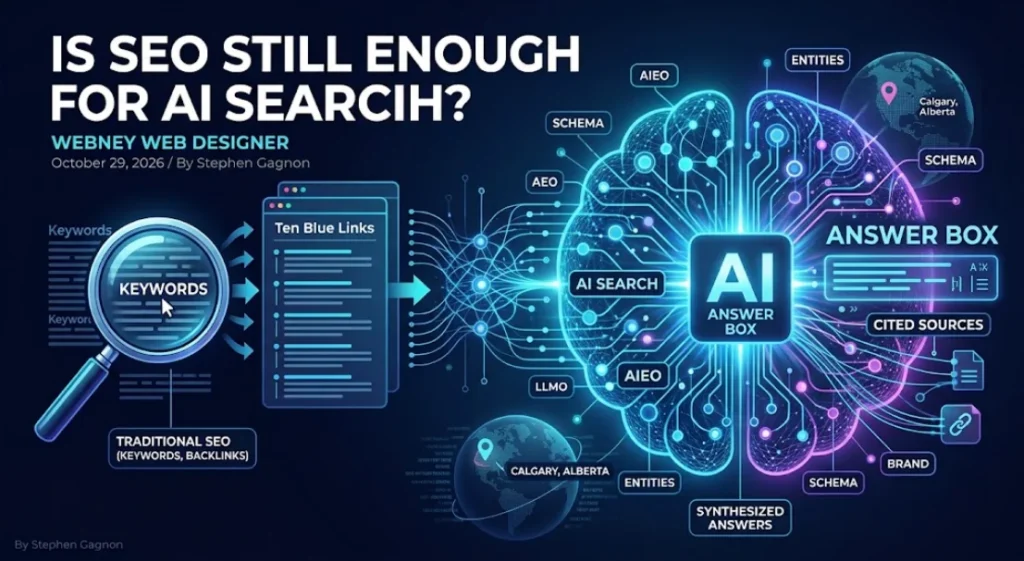
If you type a complex query into Google today, you rarely just get a tidy list of ten blue links anymore. Instead, you are greeted by an expansive AI-generated summary, conversational sidebars, contextual multi-source synopses, and instant answers that resolve your intent before your eyes even drift down the page.
For business owners, digital marketers, and forward-thinking enterprises in Calgary and beyond, this shift feels seismic. For over two decades, the digital marketing playbook was straightforward: target high-volume keywords, build authoritative backlinks, rank #1, and watch the organic traffic roll in. But as generative search models, voice assistants, and zero-click answer engines fundamentally reshape how humans find information, a pressing question echoes through boardrooms: Is traditional SEO still enough?
The short answer is no. But that does not mean SEO is dead—it has evolved into something far more sophisticated. To thrive in an ecosystem governed by Large Language Models (LLMs), businesses must look beyond basic rankings and master the intersection of SEO, AEO, GEO, LLMO, and AIEO.
The Great Search Evolution: From Keywords to Answers
To understand where search is heading, we have to look closely at how user behavior has transformed. People no longer want to hunt for answers across three or four different websites. They want synthesis, speed, and immediate clarity.
When we analyze how modern discovery platforms operate, the digital landscape is dictated by five distinct optimization pillars:
- SEO (Search Engine Optimization): The foundational practice of ensuring search engine crawlers can discover, index, and rank your web pages.
- AEO (Answer Engine Optimization): Shaping content so that automated systems, voice devices, and featured snippets pull it as a direct, standalone answer.
- GEO (Generative Engine Optimization): Structuring your digital footprint so large language models (like ChatGPT, Claude, and Gemini) reference and cite your brand within conversational answers.
- LLMO (Large Language Model Optimization): Optimizing textual data structures and entity relationships so LLMs understand your brand’s context and authority.
- AIEO (AI Engine Optimization): The holistic alignment of entity data, brand authority, and technical semantics so AI algorithms trust your business as a primary source of truth.
Key Takeaway for Business Leaders
Traditional SEO gets your website indexed. Generative optimization gets your brand cited inside conversational AI responses where high-intent decisions are made.
Chart 1: Organic Search Click-Through Rates vs. AI Overviews (2022–2026)
Line Graph representation tracking average CTR for traditional top organic results compared to zero-click AI citations.
As the timeline above illustrates, zero-click behavior has accelerated dramatically. When an AI overview or automated summary dominates the viewport, users get their answers instantly.
However, this does not spell doom for businesses. It simply changes the objective. Winning today is no longer just about capturing a raw link click—it is about capturing the citation. When an AI model names your brand as the trusted source behind an industry insight, you win authority, trust, and high-intent brand impressions that traditional rankings alone could never buy.
Comparing the Modern Search Frameworks
To build a resilient digital strategy, you cannot treat SEO, AEO, and GEO as isolated silos. They function as an integrated ecosystem. Here is how they stack up side by side:
| Framework | Primary Objective | Best Suited For | Key Success Metric |
|---|---|---|---|
| SEO | Securing high traditional rankings in search result pages | Attracting users exploring deep, multi-page resources | Keyword rankings, organic traffic volume |
| AEO | Appearing as the exact, concise answer in snippet boxes | Reaching users who need immediate, factual responses | Answer box CTR, voice search placement |
| GEO / LLMO | Earning citations inside AI-generated summaries | Influencing users relying on AI assistants for research | AI citation frequency, LLM mention share |
| AIEO | Establishing holistic entity trust across machine ecosystems | Positioning your business as a definitive regional authority | Knowledge graph integration, entity footprint |
Chart 2: Conversion Intent by Search Interface Type
Bar Chart side-by-side comparison of lead conversion quality across user acquisition channels.
Why Traditional SEO Alone Fails in an AI-First Ecosystem
Old-school search optimization relied heavily on keyword frequency, meta tag tinkering, and sheer backlink volume. While technical health remains vital, AI search models operate on semantic comprehension and entity recognition.
When an artificial intelligence engine compiles a response, it does not count how many times you stuffed a keyword into a paragraph. Instead, it evaluates three core technical metrics:
- Is this entity clearly defined within structured schema data?
- Is the surrounding content authoritative, original, and verified by expert consensus?
- Can this website’s technical architecture be parsed cleanly without friction?
“AI search engines don’t reward you for shouting the loudest with keywords; they reward you for being the most coherent, structured, and trusted entity in your industry vertical.”
Chart 3: Strategic Resource Allocation for AI Search Supremacy
Doughnut Chart breakdown showing the precise resource mix required to capture both organic clicks and AI citations.
The Anatomy of an AI-Ready Digital Presence
Adapting to AI search requires a fundamental upgrade in how web architecture and content are designed. If you want your website to thrive in an era where algorithms do the heavy lifting, you need to focus on four core pillars:
- Entity-First Optimization: AI engines look at entities—people, organizations, locations, and services. Clearly defining who you are, what you do, and where you operate through robust JSON-LD structured data is non-negotiable.
- The Answer-First Content Model: Stop burying your core insights beneath three paragraphs of introductory fluff. State the answer clearly in the opening sentence, then use structured subheadings, clean bullet points, and concise tables to make your content machine-readable.
- Uncompromising Content Depth & Originality: AI models can easily synthesize basic definitions. To earn citations, your content must offer original data, proprietary research, real-world case studies, and localized expertise that automated crawlers cannot fabricate.
- A Seamless Technical Foundation: Clean semantic HTML, lightning-fast page speeds, and flawless mobile responsiveness remain the bedrock of visibility. A poorly coded website will struggle to be indexed by search engines or parsed by generative models.
Chart 4: User Visibility Heatmap on Modern AI Search Result Pages
Heat Map grid showing relative user attention density from cool (low) to warm (high activity).
HIGH ACTIVITY (92% Eyeball Share)
WARM ACTIVITY (74% Eyeball Share)
MODERATE ACTIVITY (38% Eyeball Share)
COOL ACTIVITY (< 8% Eyeball Share)
Navigating the Shift with Expert Partners
The evolution of search can feel overwhelming for business owners who just want to focus on running their companies. Staying ahead of algorithm updates, zero-click shifts, and generative search trends requires constant technical vigilance and creative content strategy.
That is where we come in. At Webney, we specialize in building high-performance digital solutions tailored to the modern web. Whether you are looking for custom Calgary website design services that prioritize clean semantic code, lightning-fast performance, and robust structured schema data to ensure your brand is fully understood by AI engines, we have the expertise to future-proof your business online.
Want to learn more about our team and our approach? Visit our about us page to discover how our philosophy of hand-coded excellence and technical precision sets us apart in the digital marketing landscape.
Conclusion: Future-Proof Your Brand Today
Is SEO still enough for AI search? On its own, no. But integrated with a forward-thinking strategy that embraces GEO, AEO, LLMO, and AIEO, it becomes the ultimate launchpad for digital dominance. The businesses that win tomorrow will be those that stop fighting search evolution and start optimizing for it today.
Ready to ensure your business is seen, cited, and chosen in the age of AI search? Let’s talk about your next project.
Ready to Dominate AI & Generative Search?
Don’t let your business get left behind in traditional rankings. Partner with Webney to build a high-performance, AI-ready website that drives citations, conversions, and growth.
Get in Touch With Webney Today →