Search engine optimization is experiencing the most radical paradigm shift since Google first introduced PageRank. For nearly three decades, digital marketing revolved around a simple objective: earn a top slot on a search results page, capture a user’s click, and convert that visitor on your website.
That playbook is no longer enough.
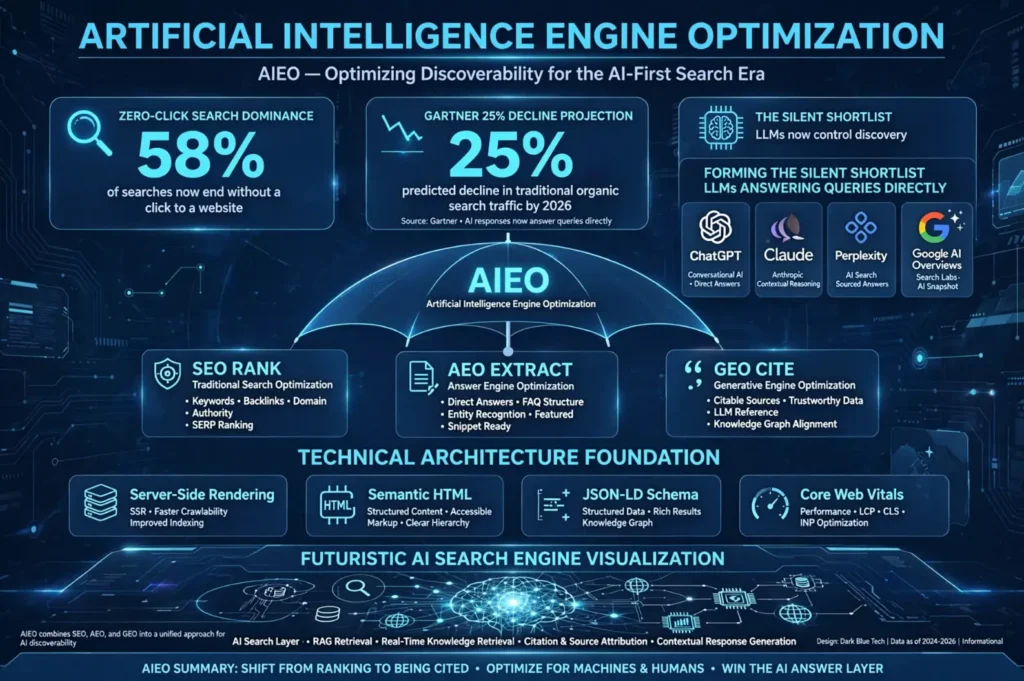
Industry data indicates that over 58% of Google searches now end without a single click to an external website. Gartner projects a 25% decline in traditional search engine query volume as zero-click searches and direct answers become the primary way people consume information online. When potential clients ask ChatGPT, Claude, Perplexity, or Google AI Overviews for service recommendations, these systems do not display a list of ten blue links. They synthesize vast streams of data in real-time, delivering a single, cohesive answer that forms a “silent shortlist” of brands before a buyer ever sets foot on your site.
If your digital presence is not engineered to be understood, cited, and recommended by Large Language Models (LLMs), your business risks becoming completely invisible.
Welcome to Artificial Intelligence Engine Optimization (AIEO)—the unified discipline governing search visibility in the age of generative search. Here is a comprehensive guide to understanding AIEO, why high-performance website architecture is its foundation, and how your business can capture market share across every AI search engine.
What Is Artificial Intelligence Engine Optimization (AIEO)?
To master AI search visibility, we must first clarify the evolving terminology. Over the last two years, marketers have thrown around acronyms like SEO, AEO, & GEO. While they are often used interchangeably, they represent distinct layers of digital discovery.
Artificial Intelligence Engine Optimization (AIEO) serves as the overarching umbrella strategy that unifies three core pillars:
- Search Engine Optimization (SEO): The technical and content foundation required to crawl, index, and rank web pages on traditional search engines like Google and Bing.
- Answer Engine Optimization (AEO): The practice of structuring data and content to be extracted into direct, zero-click answer blocks, featured snippets, and knowledge panels.
- Generative Engine Optimization (GEO): The strategic alignment of your brand authority, content depth, and web presence so that AI engines (such as ChatGPT, Perplexity, and Gemini) cite and recommend your business in conversationally generated answers.
┌─────────────────────────────────────────────────────────┐
│       ARTIFICIAL INTELLIGENCE ENGINE OPTIMIZATION       │
│                         (AIEO)                          │
└────────────────────────────┬────────────────────────────┘
                             │
     ┌───────────────────────┼───────────────────────┐
     ▼                       ▼                       ▼
┌─────────┐             ┌─────────┐             ┌─────────┐
│   SEO   │             │   AEO   │             │   GEO   │
│ (Rank)  │             │ (Extract)│            │  (Cite) │
└─────────┘             └─────────┘             └─────────┘
Rather than competing strictly for ranking positions, AIEO focuses on Share of Model—ensuring your brand is consistently referenced when generative engines answer queries related to your industry.
| Optimization Pillar | Primary Target | Core Objective | Key Metric |
| SEO | Traditional Search Crawlers | Higher positions on SERPs | Organic Traffic & Click-Through Rate (CTR) |
| AEO | Zero-Click Featured Snippets | Providing rapid, extractable direct answers | Knowledge Panel & Featured Snippet Share |
| GEO | Large Language Models (LLMs) | Influencing AI syntheses and brand mentions | Share of Model & Citation Frequency |
| AIEO | Integrated AI Search Ecosystem | Total digital brand presence across all AI surfaces | Branded Lead Pipeline & Multi-Surface Visibility |
The Science of AI Citations: How LLMs Select Their Sources
To optimize for AI engines, you must understand how these models evaluate web pages. AI models do not read websites the way humans do, nor do they rely solely on keyword density or link counts like legacy search algorithms. Instead, generative models evaluate content through semantic relevance, structural clarity, and source authority.
Landmark research from Princeton University (Aggarwal et al.) evaluated the impact of specific content enhancements on generative engine visibility. The findings revealed clear patterns in what causes AI tools to pull, cite, and recommend content:
- Statistics and Data Boost (+40% Visibility): Content enriched with verifiable statistics, primary data, and quantitative facts saw up to a 40% increase in citation rates compared to generic text.
- Direct Quotations and Expert Citations (+41% Visibility): Generative engines favor content featuring direct quotes from industry experts, credible sources, and authoritative figures.
- Fluency and Plain Language: AI models favor clear, direct language with clean formatting over complex jargon or fluff-heavy intros.
  Content Factor              AI Visibility Impact
  ───────────────────────────────────────────────────────────
  Adding Verifiable Stats     [████████████████████] +40%
  Adding Expert Quotations    [█████████████████████] +41%
  Plain Language & Structure  [████████████████] +32%
Furthermore, AI engines look beyond your own domain. LLMs build sentiment maps of your brand by scanning third-party platforms, unlinked brand mentions, user-generated content (UGC) platforms like Reddit and YouTube, and reputable local directories. If the broader web agrees that your company is a trusted provider, generative models will confidently recommend you to prospective buyers.
Why Technical Web Design Is the Foundation of AIEO
A common misconception is that AI Engine Optimization is purely a copywriting discipline. In reality, GEO and AIEO are heavily dependent on your website’s underlying technical architecture. If AI crawlers struggle to render your website code, parse your structure, or verify your site speed, your content will be completely bypassed by language models.
At Webney, we engineer digital assets with clean code, fast loading performance, and semantic HTML structures—giving AI crawlers immediate access to key brand information.
┌─────────────────────────────────────────────────────────┐
│               TECHNICAL AIEO ARCHITECTURE               │
├─────────────────────────────────────────────────────────┤
│  1. Server-Side Rendering (SSR) ──> Instant Crawler Access │
│  2. Semantic HTML Tags (H1-H3)  ──> Clear Logical Hierarchy │
│  3. JSON-LD Schema Snippets    ──> Machine-Readable Data│
│  4. Core Web Vitals Speed       ──> Low Crawl Friction   │
└─────────────────────────────────────────────────────────┘
Here are three non-negotiable technical requirements for AI search visibility:
1. Server-Side Rendering over Heavy Client-Side JavaScript
AI crawlers (such as GPTBot, ClaudeBot, and PerplexityBot) operate under tight computational budgets. Unlike human browsers, AI crawlers often fail to execute complex client-side JavaScript frameworks smoothly. If your site relies entirely on client-side rendering, an AI crawler may index a completely blank canvas. Utilizing server-side rendering ensures that your text, headings, and schema are delivered instantly in raw HTML.
2. Semantic Code Architecture & Heading Hierarchy
Generative engines break web pages down into logical chunks to process information efficiently. Proper semantic tags (<article>, <section>, <h1>, <h2>, <h3>, <p>) signal precise relationships between context and answers. When businesses take advantage of our Calgary website design services, we build hand-crafted HTML/CSS frameworks that strip away excess code clutter, enabling search bots and AI models to parse data without friction.
3. Structured Data (JSON-LD Schema Markup)
Schema markup serves as a universal language for machines. By embedding structured data (such as LocalBusiness, Organization, Service, and FAQPage schema), you directly inform AI models about your business locations, service offerings, customer ratings, and expertise. This structured context allows AI search engines to pull exact answers directly into zero-click environments.
The 4-Step Operational Framework for AIEO Success
Ready to future-proof your digital presence? Implementing a modern AI Engine Optimization campaign requires a structured, multi-channel strategy.
  ┌────────────────────────────────────────────────────────┐
  │ STEP 1: Prompt Intent Mining                           │
  │ Identify exact buyer queries across AI assistants.    │
  └───────────────────────────┬────────────────────────────┘
                              │
  ┌───────────────────────────▼────────────────────────────┐
  │ STEP 2: Structured Answer Creation                     │
  │ Write concise answers backed by stats and quotes.      │
  └───────────────────────────┬────────────────────────────┘
                              │
  ┌───────────────────────────▼────────────────────────────┐
  │ STEP 3: Off-Page Entity Alignment                      │
  │ Secure mentions across UGC, press, and directories.   │
  └───────────────────────────┬────────────────────────────┘
                              │
  ┌───────────────────────────▼────────────────────────────┐
  │ STEP 4: Share of Model Measurement                     │
  │ Monitor AI citations, mentions, and conversion pathways│
  └────────────────────────────────────────────────────────┘
Step 1: Mine High-Intent Buyer Prompts
Traditional keyword research focuses on short-tail search phrases (e.g., “custom web designer”). AIEO targets conversational, multi-dimensional prompts (e.g., “Which web design agencies specialize in fast, custom-coded websites for local service businesses?”).
Extract real customer questions from your sales calls, contact form submissions, and customer support channels. Identify the precise pain points, comparison parameters, and solution criteria your audience evaluates before making a hiring decision.
Step 2: Write Direct, Fact-Dense Content
Structure your content to immediately answer key queries. Use a “question-first” heading structure, followed immediately by a direct 2-to-3 sentence answer in plain text.
- Bad Approach: Writing 400 words of introductory backstory before explaining how a service works.
- AIEO Approach: Opening a section with a clear H2 heading (“How Does Custom Web Design Impact Core Web Vitals?”), followed by an explicit definition, two supporting statistical figures, and an expert quote.
Step 3: Expand Your Digital Footprint Outside Your Domain
Generative models do not rely solely on your website to verify who you are. Unlinked brand mentions across news portals, industry blogs, Reddit discussions, and local business registries heavily influence whether an AI trusts your brand.
To build long-term authority:
- Maintain active profiles on digital platforms where your prospective buyers ask questions.
- Collect authentic client feedback across third-party review platforms.
- Publish authoritative insights, case studies, and original research that third parties naturally reference and quote.
To learn more about us and our approach to digital strategy, explore how we combine custom human web development with data-driven search optimization.
Step 4: Track Your Share of Model & Real Revenue Metrics
Measuring organic success solely through keyword ranking tables or total site visitors is an incomplete strategy in an AI-driven market. When generative engines deliver direct answers, your site may experience fewer casual clicks, but the traffic you do receive will carry significantly higher commercial intent.
Track AI Engine Optimization progress by monitoring:
- AI Citation Frequency: How often your brand or URL is cited when prompting ChatGPT, Claude, Gemini, or Perplexity with industry queries.
- Branded Search Volume: Growth in prospective clients searching for your company by name after discovering you inside AI syntheses.
- Qualified Lead Conversions: Measuring direct phone inquiries, booked consultations, and form submissions from decision-ready buyers.
Our track record speaks for itself—take a moment to browse our verified client reviews to see how high-performance website architecture translates into real business growth.
Dominate Traditional Search and Generative AI
The shift from traditional search engines to generative AI search is not a trend you can afford to ignore. However, winning in this new environment does not mean discarding traditional SEO principles. AI models rely on the same foundational web infrastructure: fast page load speeds, clean semantic code, clear entity structures, and undeniable market authority.
By combining precision technical web design with strategic AI Engine Optimization, your company can capture market share across traditional search engines and AI assistants alike.
Ready to build a high-performance website engineered for traditional SEO and generative AI visibility? Contact our development and search specialists through our contact page to discuss your next digital project today!